
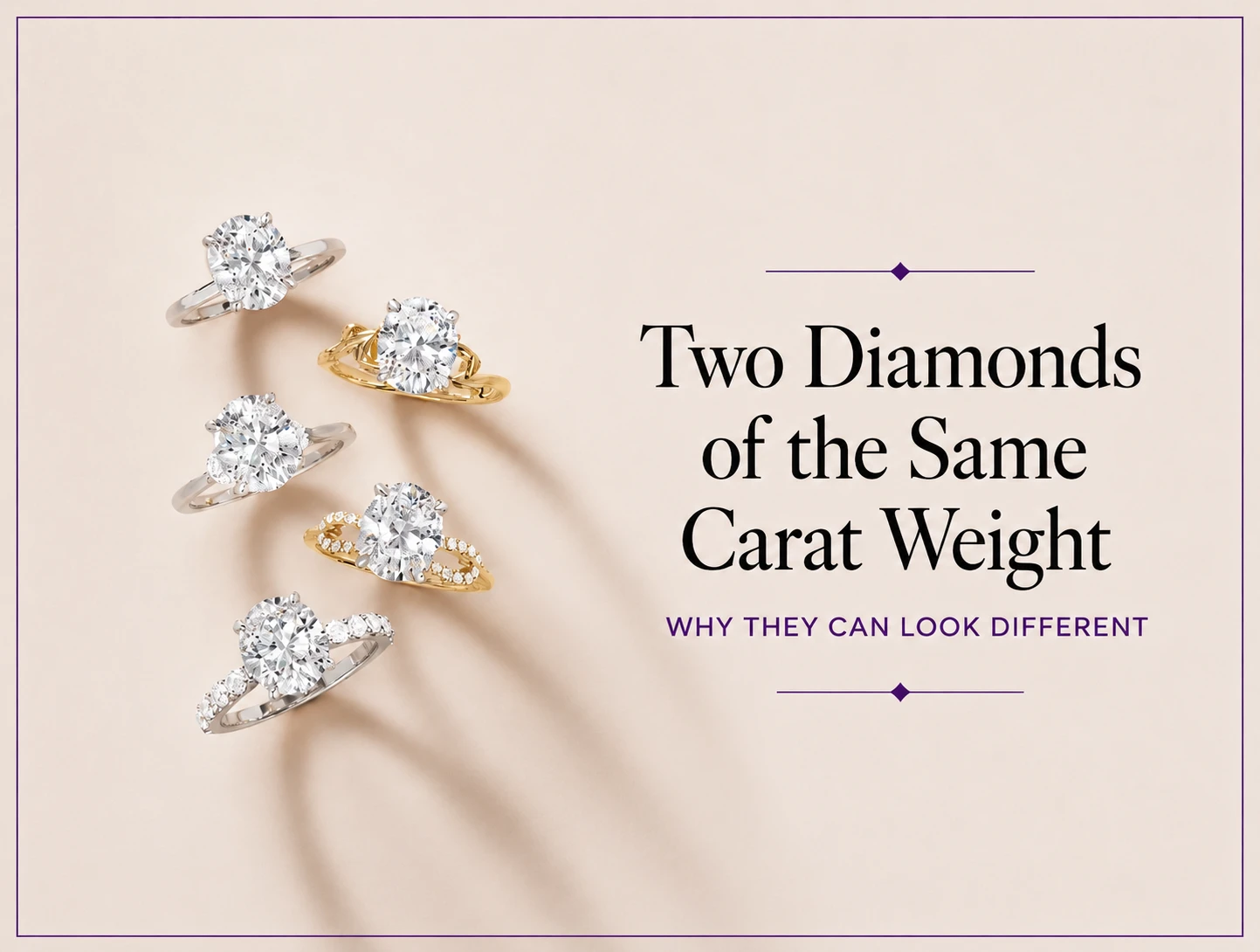
Why Two Diamonds of the Same Carat Weight Can Look Different
When shopping for a diamond, carat weight is often one of the first details people compare. It is easy to assume that two 1 carat diamonds will look virtually identical in size. In reality, two diamonds with the exact same carat weight can look noticeably different once they are set in a ring.
Why? Because carat measures weight, not how large a diamond appears from the top.
A diamond's cut, shape, proportions, and even its setting can influence its visual size. Understanding these differences can help you look beyond the number on a grading report and choose a diamond that delivers the appearance and brilliance you want.
Carat Weight vs. Visual Size
Carat is a measurement of a diamond's weight. One carat equals 200 milligrams. While a higher carat weight generally means a larger diamond, carat alone does not tell you the diamond's exact dimensions or how large it will appear on your finger.
Think of two diamonds with the same weight but different proportions. One may carry more of its weight below the surface, while another may distribute more of that weight across its visible face.
Both can weigh exactly 1 carat, but the second diamond may look larger when viewed from above. This is why focusing exclusively on carat weight can sometimes be misleading when comparing diamonds.
Cut and Proportions Make a Major Difference
A diamond's proportions determine how its weight is distributed.
A diamond that is cut too deep may hide more of its weight in the lower portion of the stone. Because that additional weight sits beneath the diamond's visible surface, the stone may appear smaller than another diamond of the same carat weight.
A diamond with well balanced proportions can offer a more desirable combination of visual size and light performance.
Diamond Shape Changes How Large a Stone Appears
Shape can also have a significant effect on perceived size.
Elongated diamond shapes tend to spread their carat weight across a larger visible area. Because of this, shapes such as oval, pear, marquise, and emerald cuts can sometimes appear larger than a round diamond of a similar carat weight.
For example, an elongated oval diamond may create more finger coverage than a round diamond at the same weight. A marquise diamond's long silhouette can create an even more dramatic visual effect.
That does not mean one shape is better than another. It simply means carat weight can present differently depending on the diamond's outline. Your ideal shape should ultimately reflect your personal style, the look you want from your engagement ring, and the characteristics you value most in a diamond.
Measurements Tell You More of the Story
When comparing two diamonds of the same carat weight, look at their actual measurements in addition to the carat number.
Diamond measurements are typically expressed in millimeters and can tell you the stone's length, width, and depth. These dimensions give you a clearer idea of how much surface area the diamond will show when viewed from above.
For round diamonds, comparing diameter can be particularly useful. For elongated shapes, both length and width matter, along with the diamond's length-to-width ratio.
The Setting Can Change the Diamond's Appearance, Too
The diamond itself is only part of the equation. Your engagement ring setting can also influence how large the center stone appears.
A halo setting surrounds the center diamond with smaller diamonds, creating additional sparkle and a larger overall visual footprint. A slender band can create contrast that makes the center stone feel more prominent, while certain prong styles can leave more of the diamond visible.
Three stone and side stone settings can create additional finger coverage and brilliance, while a classic solitaire keeps the focus entirely on the center diamond.
This is one reason choosing the diamond and setting together can be so helpful. Instead of evaluating the center stone alone, you can consider how the entire engagement ring will look once everything comes together.
Look Beyond the Carat Number
Carat weight is an important part of choosing a diamond, but it should never be the only number you consider. Most importantly, consider how the diamond actually looks to you. Two diamonds can share the same carat weight on paper and still create completely different impressions in person.
Find the Diamond That Looks Right to You at Gage Diamonds
Choosing an engagement ring is about more than checking boxes on a grading report. The right diamond should offer the beauty, proportions, brilliance, and presence that fit your style and priorities.
At Gage Diamonds, our team can help you compare diamonds beyond carat weight, understand how different shapes and proportions affect their appearance, and pair your diamond with an engagement ring setting that brings your vision to life.
Ready to start your search? Explore Gage Diamonds engagement rings online or visit us in our Chicago showroom to discover the diamond that feels right for you.